George W. Bush by James Mann
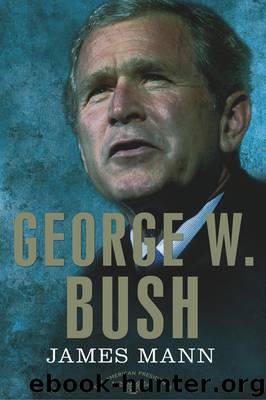
Author:James Mann
Language: eng
Format: epub
ISBN: 9781627792301
Publisher: Henry Holt and Co.
7
Second-Term Changes
Immediately following the 2006 congressional elections, George W. Bush took the momentous step he had been considering for several years. He announced that Donald Rumsfeld would step down as defense secretary. As his replacement, Bush selected Robert Gates, the veteran intelligence official who had served in the George H. W. Bush administration as deputy national security adviser and as director of central intelligence.
This was not merely a personnel change at the Pentagon but a shift in the center of gravity and worldview of Bush’s foreign-policy team. Gates was closely allied with the realists in George H. W. Bush’s administration who had favored a balance-of-power approach over idealism and preferred cautious multilateral diplomacy to unilateralism. Over the years, he had learned the ways of national security in Washington from two former bosses, Brent Scowcroft and Zbigniew Brzezinski, who by 2006 had become the two most prominent critics within the foreign-policy community of George W. Bush’s decision to invade Iraq.
The ouster of Rumsfeld was a significant blow to the power and influence of Vice President Cheney. Rumsfeld had been Cheney’s close friend for decades and his steadfast ally on policy questions. Twice in the previous two years, Cheney had persuaded Bush not to let Rumsfeld go. A few days before the 2006 elections, however, Bush called the vice president aside and informed him that after Election Day he was making the change Cheney had long opposed. It was an icy meeting. “This time the president didn’t wait around after he told me he had made up his mind,” Cheney wrote later. “He turned and was out the door fast.”
Bush fully understood the implications for his vice president. At the end of an interview with Gates for the Pentagon job, he had asked if Gates had any further questions. Then, smiling, Bush prompted, “Cheney?,” raising on his own the sensitive question of Cheney’s role in the administration that Gates hadn’t asked. “He is a voice, an important voice, but only one voice,” the president said.
Cheney’s position had already been weakened by the indictment in late 2005 of I. Lewis “Scooter” Libby, his chief of staff. With Rumsfeld’s departure, the vice president became increasingly a minority voice within the administration; his hawkish views on foreign policy no longer dominated. During the final two years of his presidency, Bush would make a series of decisions, particularly on foreign policy, over Cheney’s opposition.
The replacement of Rumsfeld was not so much the catalyst for a change of direction for Bush as it was the crowning moment for a change that was already under way. From the first days of Bush’s second term, his administration had increasingly taken on a different tone and emphasis as the president sought to counteract the negative impact of his invasion of Iraq. He by then had strong reasons of self-interest to pursue the multilateral approaches he had forsaken earlier; in Iraq, for example, he was now eager for European aid and personnel to alleviate the chaos that had erupted after the American invasion.
Download
This site does not store any files on its server. We only index and link to content provided by other sites. Please contact the content providers to delete copyright contents if any and email us, we'll remove relevant links or contents immediately.
Fanny Burney by Claire Harman(26607)
Empire of the Sikhs by Patwant Singh(23090)
Out of India by Michael Foss(16861)
Leonardo da Vinci by Walter Isaacson(13342)
Small Great Things by Jodi Picoult(7156)
The Six Wives Of Henry VIII (WOMEN IN HISTORY) by Fraser Antonia(5519)
The Wind in My Hair by Masih Alinejad(5104)
A Higher Loyalty: Truth, Lies, and Leadership by James Comey(4967)
The Crown by Robert Lacey(4821)
The Lonely City by Olivia Laing(4808)
Millionaire: The Philanderer, Gambler, and Duelist Who Invented Modern Finance by Janet Gleeson(4483)
The Iron Duke by The Iron Duke(4367)
Papillon (English) by Henri Charrière(4278)
Sticky Fingers by Joe Hagan(4208)
Joan of Arc by Mary Gordon(4119)
Alive: The Story of the Andes Survivors by Piers Paul Read(4037)
Stalin by Stephen Kotkin(3973)
Aleister Crowley: The Biography by Tobias Churton(3647)
Ants Among Elephants by Sujatha Gidla(3472)
